1. Core Pillars of Digital Marketing
To understand digital marketing, you have to look at the different "engines" that drive traffic and sales.
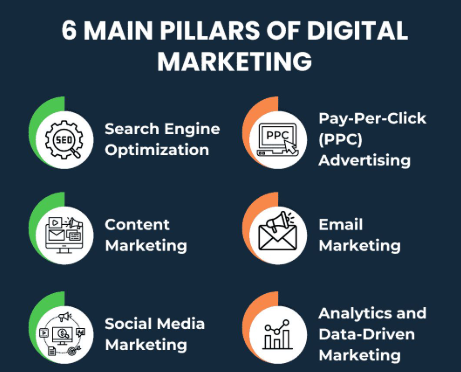
Search Engine Optimization (SEO): The art of ranking higher on Google or Bing organically (without paying for ads). It focuses on keywords, site speed, and high-quality content.
Search Engine Marketing (SEM) / PPC: This is the "paid" side of search. You bid on keywords (Pay-Per-Click) to appear at the top of search results instantly.
Social Media Marketing (SMM): Using platforms like Instagram, TikTok, LinkedIn, and X to build a brand, engage with followers, and run targeted ads.
Content Marketing: Creating valuable "free" stuff—blogs, videos, podcasts, and infographics—that solves user problems and builds trust.
Email Marketing: One of the highest ROI (Return on Investment) channels. It’s about nurturing leads and keeping customers updated through direct, personalized communication.
Affiliate & Influencer Marketing: Partnering with individuals or other businesses who promote your product to their audience in exchange for a commission or fee.
How the "Funnel" Works
Digital marketing follows a journey called the Marketing Funnel: Awareness: The customer discovers your brand (via an Instagram ad or a Google search). Consideration: They research you, read your blog, or follow your page. Conversion: They make a purchase or sign up for a service. Loyalty/Advocacy: They become a repeat customer and tell their friends.
Key Metrics (The "KPIs")
To know if you’re winning, you have to track the data:
CTR (Click-Through Rate): The % of people who saw an ad and clicked it.
CPC (Cost Per Click): How much you pay every time someone clicks.
ROI (Return on Investment): How much profit you made compared to what you spent.
Conversion Rate: The % of visitors who actually bought something.
Modern Trends to Watch
Digital marketing is currently being reshaped by three major forces:
AI Integration: Tools like me (Gemini) are used to write copy, generate images, and predict customer behavior.
Short-Form Video: TikTok, Reels, and Shorts are currently the highest-engagement formats.
Privacy & Data: With the "death of the cookie," marketers are focusing more on "First-Party Data" (info customers give willingly).
The "Service-Based" Description (For an Agency or Resume)
Digital marketing is an umbrella term for a suite of online growth strategies, including: Search Engine Optimization (SEO): Increasing organic visibility. Pay-Per-Click (PPC): Driving immediate, targeted traffic. Content Strategy: Building authority through high-value media. Conversion Rate Optimization (CRO): Turning website visitors into paying customers.
The "AI-First" Shift
AI has moved from a writing tool to the "brain" of marketing operations.
Generative Engine Optimization (GEO): Brands no longer just optimize for Google’s blue links. They optimize to be the "cited source" in AI summaries (like Gemini, Perplexity, and ChatGPT)..
Agentic Marketing: Companies are deploying "AI Agents"—autonomous systems that don't just chat, but actually help customers research, compare products, and complete purchases without human intervention..
Predictive Personalization: AI now predicts a customer’s "Next Likely Action." Instead of reacting to a click, brands are serving content based on where the AI thinks the user is headed..
Content Trends: "The Human Premium"
Because AI can generate infinite content, "perfect" but generic blogs are losing value.
Short-Form Video (Still King): TikTok, Reels, and Shorts remain the top discovery engines. However, the trend has shifted toward "Low-Fi" Authenticity—unscripted, raw videos often perform better than high-budget productions.
Virtual & Hybrid Creators: We are seeing the rise of "Virtual Influencers" (AI-generated avatars) that interact with fans 24/7, alongside human creators who use AI to "clone" their voices for multilingual reach.
Interactive Content: Static PDFs are dead. 2026 marketing relies on AR (Augmented Reality) "try-ons," calculators, and choice-based video stories.
Privacy-First Marketing:
Transparency is now a competitive advantage. Brands that are clear about how they use data are seeing higher conversion rates than those using aggressive "shadow" tracking.
Scroll to Top